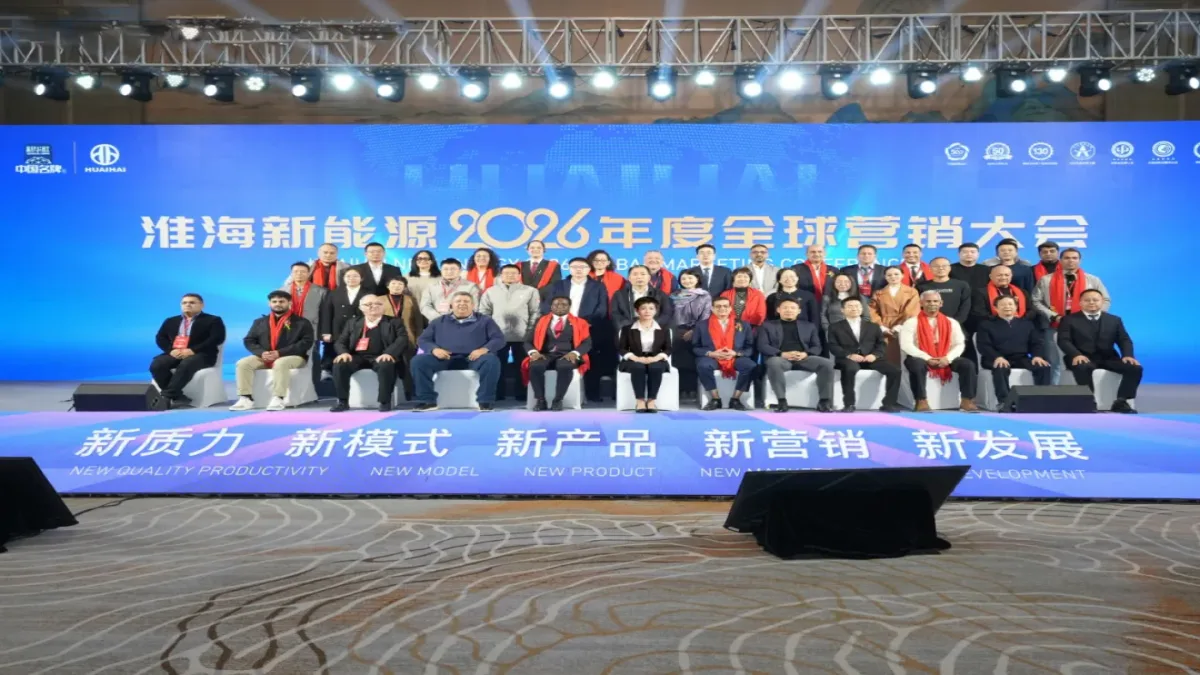
On January 16, 2026, Huaihai New Energy used its Global Marketing Conference in Xuzhou to present a range-extended HIGO passenger platform. The platform was described with electric drive as the primary propulsion source and fuel as backup. That boundary matters: range-extended does not mean battery-only, pure electric, or zero-emission.
The conference report was published on January 20. Its localization theme can give a distributor a reason to turn a platform presentation into a local demonstration, but it does not establish commercial availability, approval, local production, climate performance, or road legality in a destination. The group photograph used here documents the conference context; it does not show a HIGO vehicle or prove a product feature.
For a Gulf resort or campus mobility distributor, a short shaded route with repeat stops and a showroom handoff can create useful local observations before more display or demonstration stock is considered. This setting does not provide evidence of a Gulf launch or tested regional performance.
Define the decision before drawing the route
Write down what the demonstration must inform: repeat the route with revised controls, retain one display unit, begin a wider local evaluation, or pause. The route is not a certification or performance test. It is a structured way to collect driver, passenger, charging, fuel-backup, and service questions under the distributor's own controlled conditions.
Identify the exact vehicle and current configuration separately from the conference presentation. Record the model reference, supplied documents, visible labels, energy and charging information provided for that unit, service contact, and any operating boundaries set by responsible local parties. Do not transfer facts from another HIGO name or generation. In particular, HIGO-II must not be treated as electric merely because the names are similar.
The showroom starter display can help organize the display role while the local unit file controls what may be demonstrated.
Build repeatable route segments
Use a small number of observable segments rather than one long drive. A controlled route might include the departure briefing, repeated boarding and exit, low-speed transitions, a defined waiting point, several normal stops, a charging-area discussion, and a return to the showroom or service handoff.
For each segment, state its purpose and the observations to record. The boarding segment can capture the sequence of entry, assistance requested, personal-item placement, and passenger questions. The repeated-stop segment can capture driver actions, passenger comments, dwell time, and questions raised. The handoff can test whether staff can identify the responsible service and documentation path.
Route design must follow local site rules and qualified advice. The demonstration provides no conclusion about public-road use, passenger capacity, speed, range, safety, ride quality, heat performance, or suitability.
Keep an observation sheet, not a sales score
Give the driver, passenger observer, showroom staff member, and service representative separate fields. Record actions and words neutrally rather than asking whether the platform is comfortable or reliable.
Useful fields include:
- Segment, stop, time, and reason for any route change.
- Entry, exit, visibility, waiting, and personal-item observations.
- Driver control or training questions and any repeated uncertainty.
- Charging access, connection, scheduling, and documentation questions.
- The point at which fuel backup is explained or discussed.
- Service access, parts, tools, training, and escalation questions.
- Follow-up evidence required and the person responsible for obtaining it.
Keep charging and fuel-backup questions distinct. Electric drive is primary in the range-extended description, while fuel provides backup; neither side should be omitted or rewritten into a pure-electric story. The observation sheet should record what the local team needs to understand about both without inventing range, consumption, or operating figures.
End at the service desk
The last route segment should be a service and showroom handoff. Ask staff to identify the current manuals, training needs, maintenance access questions, relevant parts list, and escalation route for the exact demonstration unit. Record which powertrain questions can be answered from current files and which require clarification.
The showroom and service plan connects a passenger display with staff readiness. The Huaihai FAQ separates general sourcing questions from configuration-specific answers that still need evidence.
Set the rollout gate from local evidence
Review route records with showroom, operations, service, and procurement staff. Repeated questions may call for a revised briefing or another controlled route. A configuration or support gap may justify keeping one display unit without expanding. Wider rollout review should begin only when the local team can identify the unit, explain the range-extended powertrain accurately, reproduce the route record, and close the required service and destination questions.
The January presentation provides an event anchor, not a verdict. A local demo route should preserve the electric-drive-first and fuel-backup distinction while producing an observable record for the distributor's next showroom decision.