
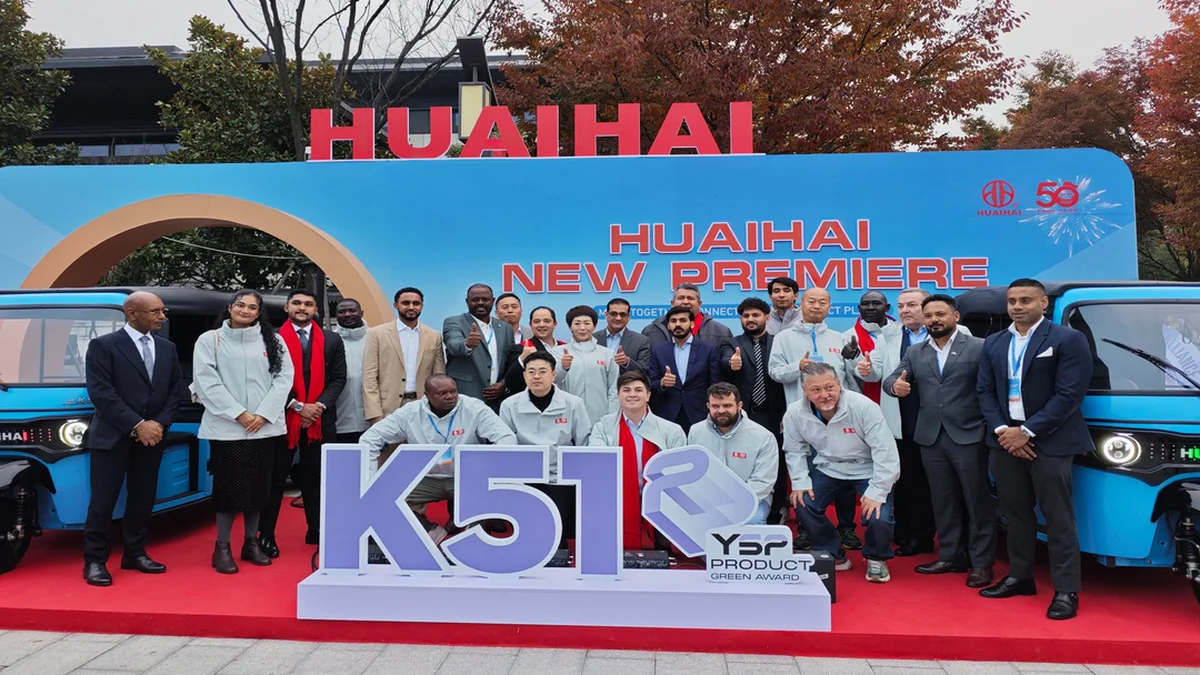
On November 17, 2026, Huaihai Holding Group held its 50th Anniversary Celebration and 2027 Global Marketing Conference in Xuzhou, Jiangsu. During the international session, Huaihai highlighted its TUKTUK passenger-mobility lineup—including the K51 passenger vehicle—as a central global focus for 2027. An R&D presentation on global TUKTUK operation solutions framed an explicit transition away from standalone vehicle transactions toward full-lifecycle operating support, spanning powertrain selection, differentiated energy-replenishment options, localized production readiness, and ongoing service coverage. A partner from Pakistan also outlined a practical expansion path from fuel-powered cargo trading into localized assembly and passenger TUKTUK operations.
For regional distributors running passenger-tricycle showrooms, that framing captures a real commercial reality. Selling the first dozen passenger units is largely a showroom presentation challenge; building repeat referrals and fleet renewals depends on whether the dealer can keep those vehicles running reliably through daily passenger shifts month after month.
Why passenger mobility breaks a transactional sales model
Cargo buyers often accept utilitarian downtime because a workshop or farm can shift loads temporarily. Passenger operators—whether running neighborhood shuttles, tourist loops, or urban commuter routes—lose daily fare revenue every hour a vehicle sits waiting for a charger, a controller, or a suspension bushing.
Moving from one-off unit sales to a lifecycle showroom model requires organizing four operational pillars before scaling display volume:
- Route-matched powertrain guidance: Separate short urban loops, hilly commuter corridors, and higher-load multi-row passenger routes in showroom consultations rather than pitching one powertrain configuration to every buyer.
- Practical energy-replenishment planning: Map how local drivers actually recharge—overnight home charging, depot plug-in banks, or removable/modular pack workflows where supported—and verify local grid stability, voltage standards, and charger spare availability before recommending a battery layout.
- Predictable preventive maintenance: Publish a simple, local-language service schedule covering brake checks, tire rotation, suspension fasteners, steering bearings, lighting, and weather-canopy seals so operators budget maintenance instead of waiting for breakdowns.
- Visible workshop readiness: Show prospective buyers the local parts shelf and diagnostic bench during the showroom visit; seeing stocked wear parts builds more buyer confidence than brochure claims.
Staging the transition from cargo trading to passenger TUKTUKs
Many international distributors enter electric mobility through cargo vehicles or fuel-powered three-wheelers before adding passenger models such as those across the Huaihai product range. Adding passenger tricycles to an existing cargo dealership changes daily showroom habits more than most teams expect:
| Dealer area | Cargo trading habit | Passenger TUKTUK showroom requirement |
|---|---|---|
| Customer test ride | Quick yard check of bed size and throttle pull | Seated boarding check across every passenger row, entry step height, legroom, canopy sightlines, and low-speed ride comfort |
| Vehicle handover | Basic key and charger delivery | Structured driver briefing on charging habits, battery care, passenger weight balance, wet-road braking, and daily pre-shift checks |
| Parts stocking | Heavy focus on axles, leaf springs, and cargo hardware | Balanced inventory adding cabin glazing, mirror brackets, weather curtains, seat upholstery mounts, controllers, and dedicated chargers |
| After-sales response | Scheduled drop-off repair | Fast-turnaround wear-part bay and clear warranty-claim documentation to minimize lost operator shift hours |
Distributors preparing to launch or expand a dedicated passenger floor can pair this operational lens with the showroom and service plan for electric tricycle dealers to map staff training, workshop tooling, and initial spare-parts budgets alongside vehicle stock.
Evaluate energy and localization claims on local facts
Consider a distributor in South Asia or East Africa expanding from legacy cargo sales into passenger TUKTUK mobility. Conference themes around differentiated energy replenishment, localized assembly, and full-lifecycle operating support provide a strong checklist of questions to bring to the quotation table—not pre-verified local guarantees.
Before committing capital to a new passenger configuration or local assembly line, document the concrete boundaries for your territory:
- Confirm exact quoted configuration: Specify seating layout, battery chemistry, charger rating, canopy/door package, and instrumentation in writing. If you are reviewing multi-row or dual-battery passenger setups, the K51 passenger configuration brief outlines the exact hardware checks to verify before ordering.
- Test localized assembly economics honestly: Assess local workshop floor space, skilled electrical technicians, jig and torque-tool costs, and customs documentation before moving from complete units to knock-down assembly.
- Verify passenger licensing and road compliance locally: Passenger-carrying vehicles face stricter safety, seating, lighting, and commercial-permit rules than private cargo units. Confirm registration category, operator licensing, and battery transport rules directly with destination regulators before ordering display stock.
Huaihai's November 2026 conference focus on all-scenario TUKTUK operations underscores where passenger three-wheel distribution is heading: the showroom floor is only the entry point. Dealers who pair comfortable, well-demonstrated passenger vehicles with clear charging guidance, stocked service parts, and repeatable handover routines turn first-time buyers into long-term fleet accounts.